Sloths
Sloths are highly successful, slow-moving mammals that spend their lives hanging about in the trees of Central and South America.
There are two types of sloth. They look quite different and are defined by how many digits they have.
Found in Central and South America, sloths call the tall trees their home, as their long claws make it difficult for them to walk on the ground. Sadly, many sloths are being taken from the wild to be used as props for tourist selfies. This shock can cause them a great deal of stress and anxiety and can cut their lifespan to as short as 6 months, where normally they can live up to 40 years.
There are two types of sloth, two-toed and three-toed. However, this can get confusing as both types have three claws, or ‘toes’, on their hind limbs. In reality, the ‘two-toed’ sloth should really be called the ‘two-fingered’ sloth as the difference between them both can be found on their front limbs.
The modern sloth is usually around the size of a medium-sized dog. But ancient sloths of years ago, known as ‘Megatherium’, could grow as large as an Asian elephant! These giant sloths sometimes featured areas of small bone discs that would act as ‘armour plating’ for protection. They became extinct around 10,000 years ago.
Sloths possess a symbiotic relationship with the algae that grows on their fur. While the sloth provides the algae with shelter and water (as sloth fur is highly absorbent), the algae provide the sloth with camouflage as well as extra nutrients through their skin.
The impressive biology of a sloth allows it to spend 90% of its life hanging upside down. Studies show that this is made possible because their organs are attached to their rib cage, which means they don’t weigh down on the lungs. This means that, unlike us, a sloth can hang upside down with no affect on its breathing.
A sloth’s diet consists mainly of buds, leaves and tender shoots, although some sloths have been known to eat insects and birds to supplement their diet. They have a multi-compartment stomach that allows them to effectively digest the tough cellulose that they eat. This proves to be a slow process, taking 30 days to digest one leaf!
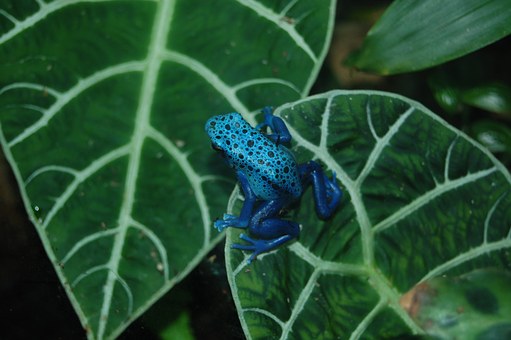
Blue Poison Dart Frog Poison Dart frogs live in rainforest habitats in Central and South America. They can be found in trees, as well as under leaves and logs and rocks on the floor of the forest.
Because of their size, from 1/2 to 2 inches long, they are hard to see. Poison frogs warn predators with brilliant colors and patterns.
There are many species of poison frogs that can be found in every color under the sun! They prey on invertebrates, especially certain ant species, which build up really strong poisons in the frog.
Dart Frogs got their name because hunters would tip their arrows in the frog’s poisons. Sadly, because people are cutting down rainforests for farming and ranching, Poison Dart Frogs are at risk.
The Blue Poison Dart Frog is the most endangered due to the pet-shop market.
Scientific name: Dendrobates tinctorius azureus
Class: Amphibia
Phylum: Chordata
Family: Dendrobatidae
Kingdom: Animalia
Did you know: The blue poison dart frog feeds on ants, beetles, flies, mites, spiders, termites, maggots, and caterpillars.
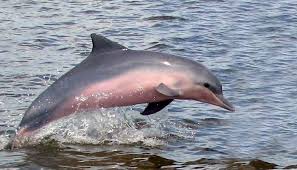
Pink Amazon River Dolphin Pink River Dolphin is a specie of dolphin that is found in the fresh water of Amazon river.
It is the largest among all the river dolphin species and have certain unique adaptations which makes them different from the other river dolphin species.
Not all of the Pink river dolphins are pink. Mostly the young ones are grey and they get pink as they age. The adult male are more pinker than the females.
Several hypothesis exits for their pink color which are:
This color is due to the blood vessels beneath their thin skins.
Their scar tissue is pink in color and they fight a lot with each other thus they develop a pink color over time.
The pink color also matches the red mud that occurs when the river flows in heavy rains.
Some pink river dolphins are pink underneath and grey on the like other dolphins which are dark colored on the back and light colored underneath. This helps them in hiding from predators
Among all the river dolphins in the world, amazon river dolphin is the largest river dolphin.
They are also the most intelligent of the five living species of river dolphins.
Their brain capacity is 40% larger when compared to that of humans.
These dolphins do sleep but with one eye open.
They often swim upside down.
Unlike other dolphins they are not acrobatic.
Unlike other river dolphin species, the male pink river dolphins are larger than the females.
For very long time they were considered as mythical creatures. Anteaters
Anteaters are funny-looking creatures that can be found in Central and South America. They live in grasslands, woodlands, rainforests and deciduous forests. There are four types of anteaters. Some of them are near threatened species.
Anteaters can be small as a squirrel (silky anteaters) or 7 feet long, counting from the tip of the nose to the end of its tail (giant anteaters).
Anteaters are toothless creatures.
They use their long and sticky tongue to catch prey.
Tongue can be 2 feet long. It is narrow and covered with tiny spines.
Anteaters catch ants and termites through the hole on the top of the anthill.
They never destroy anthill because they plan to come and eat another portion of ants in the future.
Since ants can bite, anteaters must eat them quickly. They are flicking their tongue 150-160 times in minute during feeding to grab enough ants and avoid bites.
Digestion is facilitated by specifically designed stomach that grinds large quantity of ants and termites. Their stomach produces formic acid instead of hydrochloric acid (which is normally found in other mammals). They can eat up to 30 000 insects per day.
They have poor eyesight, but excellent sense of smell. They can detect smell 40 times better than humans. Anteaters use their nose to find food.
Anteaters have low body temperature compared to other placental mammals, just 32.7 degrees of Celsius.
They sleep 15 hours per day.
spacer